When standard network measures fail to rank journals: A theoretical and empirical analysis

Abstract

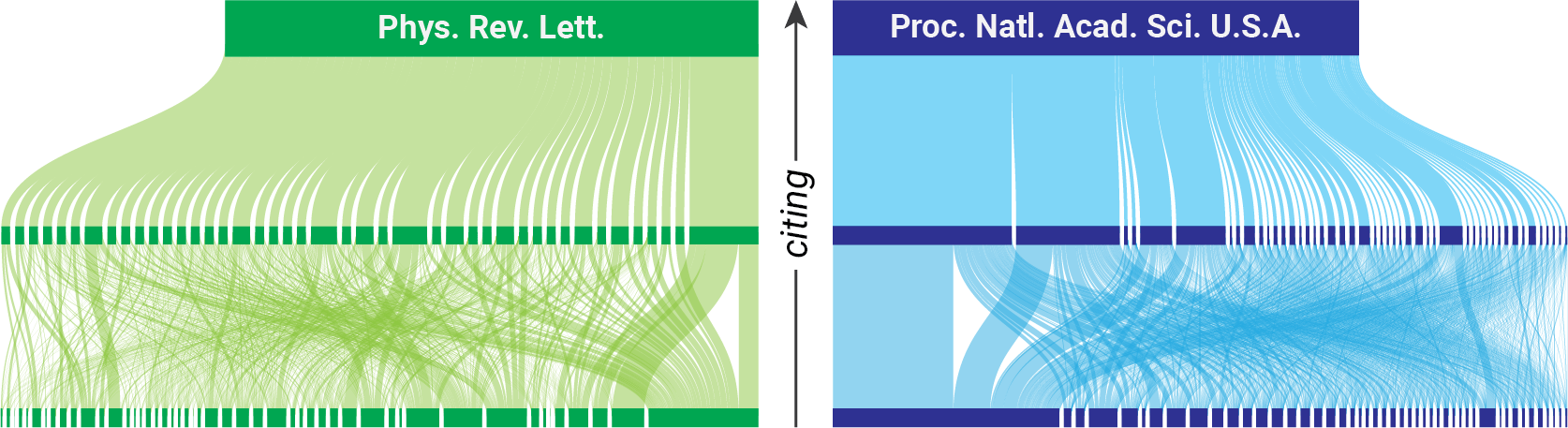
urnal rankings are widely used and are often based on citation data in combination with a network approach. We argue that some of these network-based rankings can produce misleading results. From a theoretical point of view, we show that the standard network modelling approach of citation data at the journal level (i.e., the projection of paper citations onto journals) introduces fictitious relations among journals. To overcome this problem, we propose a citation path approach, and empirically show that rankings based on the network and the citation path approach are very different. Specifically we use MEDLINE, the largest open-access bibliometric data set listing 24 135 Journals, 26 759 399 papers, and 323 356 788 citations. We focus on PageRank, an established and well-known network metric. Based on our theoretical and empirical analysis, we highlight the limitations of standard network metrics and propose a method to overcome them.
Related Posts

The mobility network of scientists: Analyzing temporal correlations in scientific careers

The mobility network of scientists: Analyzing temporal correlations in scientific careers

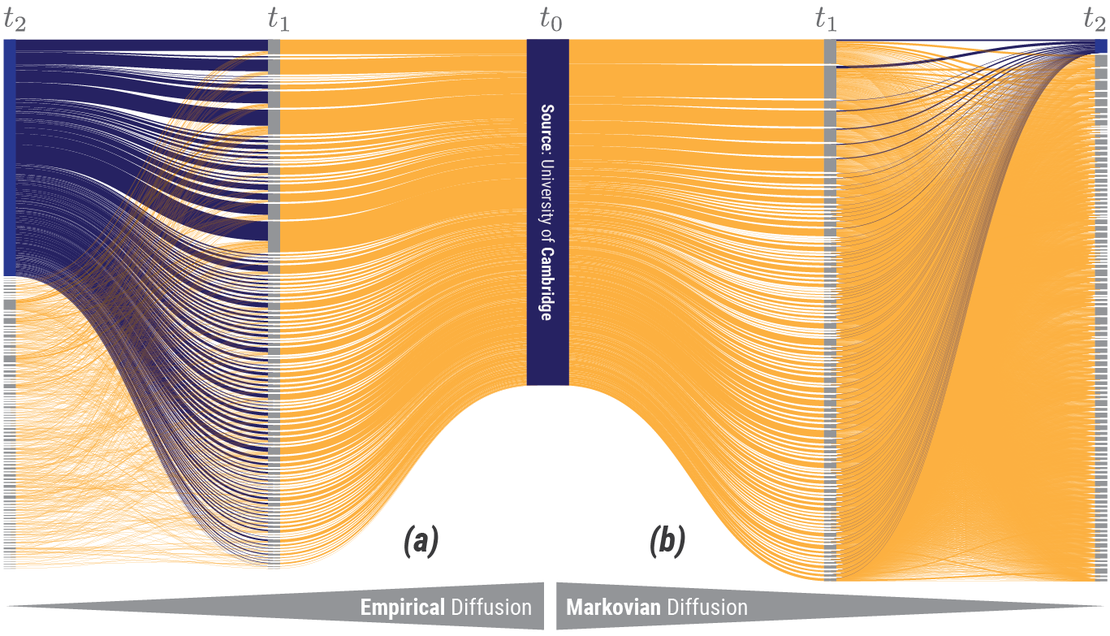
The study of scientist mobility is important for knowledge exchange and understanding the career trajectories of scientists. The researchers analyzed 3.5 million career trajectories of scientists using a novel method of higher-order networks. They found strong evidence for temporal correlations at the level of universities, indicating that scientists tend to move between specific institutions. These correlations also exist at the level of countries but not cities. The results have implications for the efficiency of mobility programs and the institutional path dependence of scientific careers.

Read More
Consensus from group interactions: An adaptive voter model on hypergraphs

Consensus from group interactions: An adaptive voter model on hypergraphs

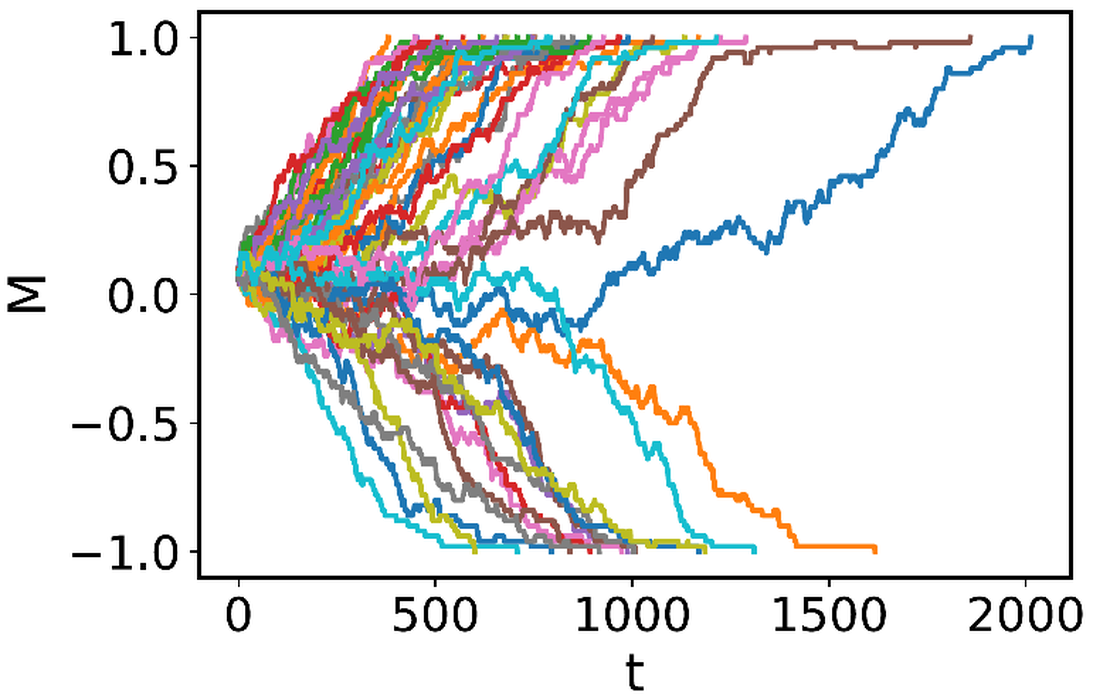
The researchers studied how group interactions affect the emergence of consensus in a spin system. They found that group interactions amplify small initial opinion biases, accelerate the formation of consensus, and lead to a drift of the average magnetization. The model considers groups of agents represented by hyperedges of different sizes in a hypergraph. The heterogeneity of group sizes is controlled by a parameter β. The study aims to understand the impact of β on reaching consensus. The researchers used computer simulations and an analytic approach to study the dynamics of the average magnetization.

Read More
Success in Science - Special Issue

Success in Science - Special Issue

Scientific Networks and Success Every researcher is affected by how scientific performance is measured. How should it be measured? Do we have the right data to do it? How can we make it fair and unbiased?

Read More